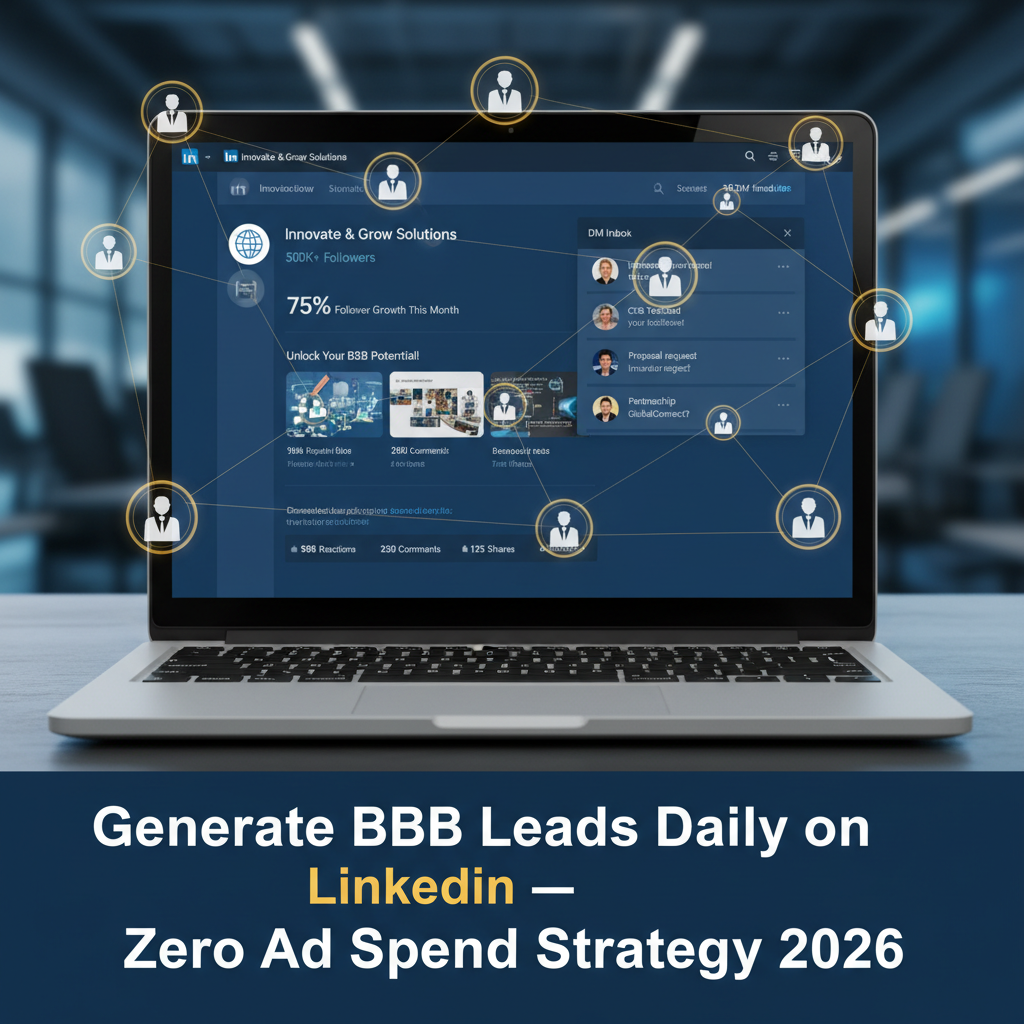
LinkedIn has 950 million
members, 60 million companies listed, and is described by HubSpot as the #1
platform for B2B lead generation — 80% of B2B social media leads originate on
LinkedIn. Yet most professionals and businesses use it only as a digital
resume, missing its most powerful functions entirely.
This guide shows exactly how to
optimize your presence, create content that reaches decision-makers, and build
a consistent pipeline of B2B leads through LinkedIn without spending on
advertising.
Why LinkedIn Outperforms Other Platforms for B2B
•
Professional mindset: LinkedIn users are in work mode —
more receptive to business-related content and offers than on leisure platforms
•
Decision-maker access: 4 out of 5 LinkedIn members
drive business decisions
•
Content longevity: LinkedIn posts can remain visible
for days (vs. hours on Twitter/Instagram)
•
Direct message access: InMail and connection requests
allow direct outreach to decision-makers
•
Algorithm-friendly for organic reach: LinkedIn's
algorithm currently shows content to non-followers much more generously than
other platforms
Step 1: Profile Optimization — Your LinkedIn Real Estate
Your LinkedIn profile is your
landing page. Decision-makers reviewing your profile decide within seconds
whether to connect, read your content, or reach out. Every element must work
together.
Headline
The LinkedIn headline is the
most visible text after your name. Do not waste it with your job title.
Instead, communicate your value proposition: 'I help SaaS companies reduce
churn by 40% through customer success frameworks | CS Consultant' beats
'Customer Success Manager at XYZ Corp.'
Profile Photo
Professional, friendly, and
clearly visible. Accounts with quality profile photos receive 21x more profile
views and 9x more connection requests according to LinkedIn data. Solid color
background, professional attire, face fills at least 60% of the frame.
Banner Image
The banner is premium real
estate most people leave as the default LinkedIn blue. Create a branded banner
communicating who you help and how. Tools: Canva (free) has LinkedIn banner
templates.
About Section
Write the About section as a
narrative that speaks directly to your ideal client's situation, not a resume
paragraph. Structure: the problem you solve → your approach → the results
clients get → a specific call to action. First-person voice. End with 'DM me' or
'Connect with me' and a specific reason to do so.
Featured Section
The Featured section (displayed
prominently on your profile) should showcase your most valuable content: a lead
magnet download, a case study, your best article, or a client testimonial video.
This is prime conversion real estate.
Step 2: LinkedIn Content Strategy
LinkedIn's organic reach in 2024
remains one of the most generous of any major platform. A post from a personal
profile with 2,000 connections can reach 20,000-50,000 people if it generates
strong engagement. A company page with 2,000 followers typically reaches
200-400 people — a stark difference that makes personal profiles far more
powerful for organic marketing.
Content Types That Perform on LinkedIn
Short-form text posts (under 1,300 characters)
LinkedIn truncates posts at
approximately 210 characters with a 'See more' link. The visible text before
the cut must compel people to click 'See more.' These conversational,
opinion-driven posts earn the most comments and shares.
Document/Carousel posts
Uploading a PDF as a 'document'
creates a swipeable carousel — LinkedIn's highest-engagement format. Content:
frameworks, step-by-step guides, industry insights, 'swipe to see' formats.
These generate an outsized number of saves.
Video posts
Short professional videos
(60-180 seconds) with subtitles perform strongly. LinkedIn prioritizes native
video upload over external links. Topics: insights, opinions, quick tutorials,
case study walkthroughs.
Personal stories
Counterintuitively, personal
vulnerability and behind-the-scenes content performs exceptionally well on
LinkedIn. Stories about failures, lessons learned, and non-obvious career
insights generate disproportionate reach.
LinkedIn Content Calendar
•
Monday: insight post — share a non-obvious observation
from your work
•
Wednesday: educational carousel — step-by-step guide or
framework
•
Friday: story or opinion — personal experience or
strong professional opinion
Consistency (3 posts/week
minimum) compounds reach. LinkedIn's algorithm rewards consistent publishers
with expanding reach over time.
Step 3: Strategic Connection Building
LinkedIn connections are your
organic distribution network. Every connection request should be targeted:
Who to Connect With
•
Your ideal clients' job titles in your target company
size and industry
•
People who engage with your existing content
•
Fellow creators in your niche (for content
collaboration)
•
Alumni from your university or previous employers (high
acceptance rate)
Personalized Connection Request Formula
Always include a personalized
note (300 character limit). Formula: [Specific reason I noticed them] + [Brief
relevant value offer] + [Soft CTA]. Example: 'I saw your comment on [person's]
post about customer success — aligned with my experience in SaaS retention.
Would value connecting to share perspectives.'
Step 4: LinkedIn Direct Messaging for Lead Generation
Cold DMs that open with 'I have
a service you might be interested in' are immediately deleted. The effective
outreach formula:
The Value-First Message Sequence
•
Message 1 (connection acceptance): Thank them for
connecting + a genuine observation or question about their work (no pitch)
•
Message 2 (3-5 days later): Share something
specifically useful to them — an article, resource, or insight relevant to
their situation
•
Message 3 (if engaged with Message 2): Very soft
inquiry — 'Are you actively working on [relevant challenge] right now? I have
been working on this with a few [their role type] clients recently.'
Only pitch if they express
interest or ask about your services. Premature pitching permanently closes the
conversation.
Company Page vs. Personal Profile
For most B2B businesses, the
personal profile of the founder or key team members dramatically outperforms
the company page in organic reach. Invest in both, but:
•
Personal profile: primary content publication,
networking, direct outreach
•
Company page: secondary distribution, social proof for
website visitors, LinkedIn Ads audience building
Measuring LinkedIn Marketing Success
•
Profile views (trend upward with consistent activity)
•
Post impressions per week
•
Connection request acceptance rate
•
Inbound DMs and connection requests from content
•
Leads or discovery calls attributable to LinkedIn
activity
Conclusion
LinkedIn is the most
underutilized B2B marketing channel available in 2026 for businesses willing to
invest in organic content and genuine relationship building. The strategy is straightforward:
optimize your profile to speak to your ideal client, publish consistent
valuable content, strategically build connections, and engage authentically.
The businesses that execute this consistently find LinkedIn becomes their most
reliable source of qualified inbound leads — at zero media cost.
Category:
Digital Marketing
Tags:
LinkedIn marketing B2B, LinkedIn lead generation, LinkedIn content
strategy, B2B social media, LinkedIn profile optimization