Your email separates spam from
legitimate messages without you doing anything. Spotify knows what song you'll
want to hear next. Your phone unlocks when it sees your face. Netflix
recommends a show you've never heard of, and it turns out to be exactly what you
were in the mood for. None of these things were explicitly programmed. They
learned.
That's machine learning. Not
science fiction, not magic, not the dangerous superintelligence of movies —
it's a specific and learnable approach to building software that improves
through experience. This guide explains what it is, how it works, the main
types, and why it matters, all without requiring any math or programming
background.
The Core Idea: Programming vs Learning
Traditional programming is
explicit: a programmer writes rules that a computer follows. Spam filter
version 1.0 might have been: 'if the email contains the phrase free money and
comes from an unknown sender, mark it as spam.' This works for known patterns
but fails for every new pattern that the programmer didn't anticipate.
Machine learning is different:
instead of writing rules, you give the system examples and let it discover the
rules itself. You show it thousands of emails labeled 'spam' and thousands
labeled 'not spam.' It figures out the patterns that distinguish them —
patterns far more complex and numerous than any programmer could write
explicitly. The rules emerge from data rather than being specified in advance.
How Does a Machine Actually 'Learn'?
Learning in machine learning is
a mathematical optimization process. A model starts with random initial
parameters and makes predictions on training examples. The predictions are
wrong initially. The error between the prediction and the correct answer is
measured. Parameters are adjusted in the direction that reduces that error.
This process repeats millions of times across thousands of examples until the
model's predictions are consistently accurate.
Think of it like adjusting a
radio dial to find a clear station. You turn the dial, listen, adjust toward
clearer signal, adjust away from static. Eventually you converge on the optimal
frequency. Machine learning does the mathematical equivalent across thousands
of parameters simultaneously.
The Three Main Types of Machine Learning
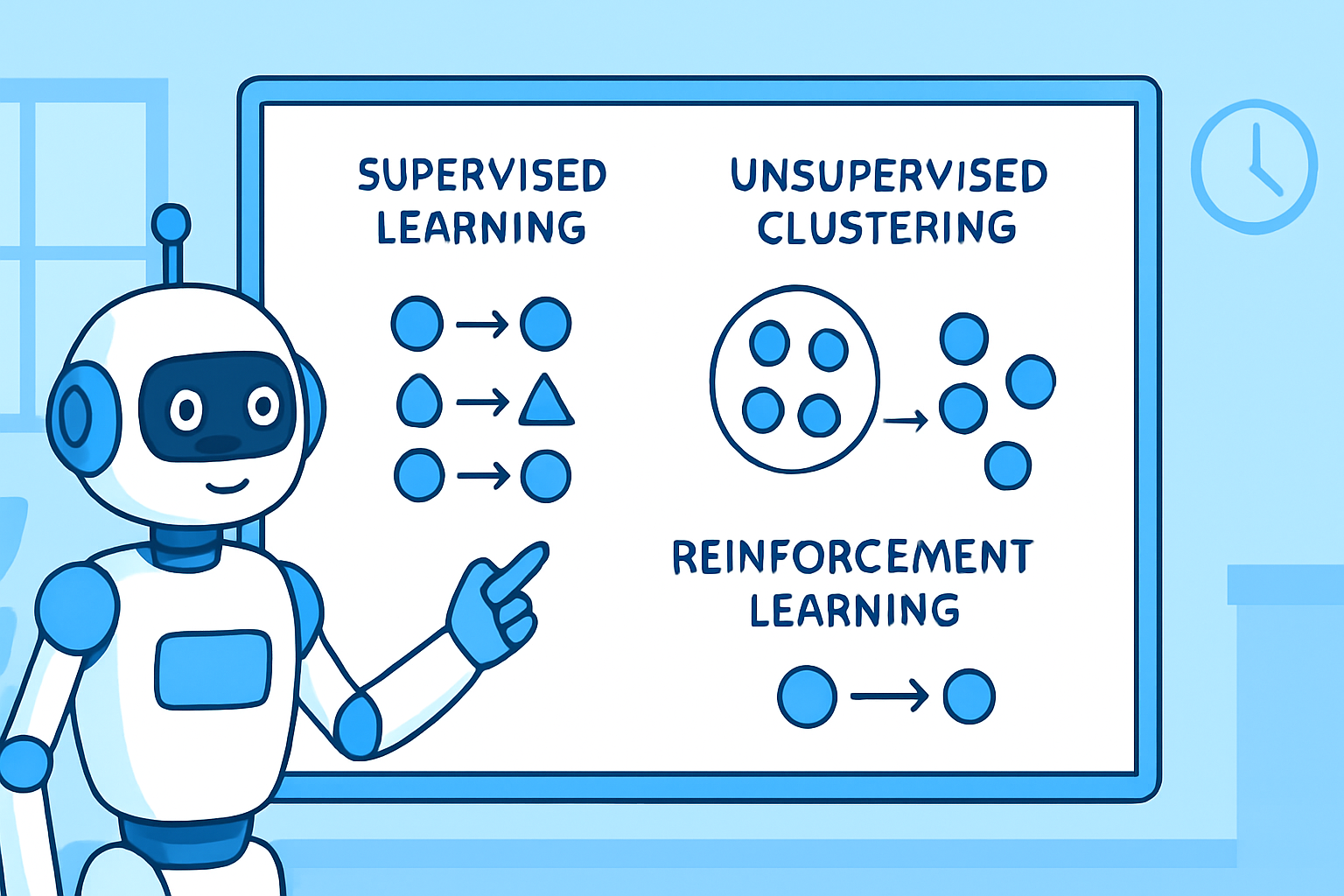
Supervised Learning
The most common type. You
provide labeled examples — inputs with correct outputs — and the model learns
the mapping between them. Examples: email spam classification (input: email
text, label: spam/not spam), house price prediction (input: house features, label:
sale price), medical diagnosis (input: symptoms and test results, label:
diagnosis). Applications include most classification and prediction tasks in
business analytics, healthcare, and finance.
Unsupervised Learning
You provide data without labels
and the model finds structure in it. The most common technique is clustering —
finding groups of similar items. Examples: customer segmentation (finding
natural groups of customers with similar behavior without pre-defining what the
groups should be), anomaly detection (finding transactions that don't fit
normal patterns), and recommendation systems (finding groups of items that tend
to be consumed together).
Reinforcement Learning
The model learns through trial
and error, receiving rewards for good actions and penalties for bad ones. This
is how AI systems learn to play games (AlphaGo, game-playing AI), control
robots, optimize resource allocation, and navigate environments. It's the most
human-like of the three types in that it mirrors how animals learn through
experience rather than instruction.
Machine Learning vs Artificial Intelligence vs Deep Learning
These terms are often used
interchangeably but have distinct meanings. Artificial Intelligence is the
broad field concerned with making computers exhibit intelligent behavior.
Machine Learning is a subset of AI — specifically, methods that learn from
data. Deep Learning is a subset of Machine Learning — specifically, machine
learning using neural networks with many layers. When people talk about AI
powering ChatGPT or image recognition, they're almost always talking about deep
learning.
Real Examples of Machine Learning in Your Daily Life
Search engines: Google ranks
billions of results using hundreds of ML models that learn what pages are
relevant to which queries. Voice assistants: Siri, Alexa, and Google Assistant
use speech recognition models trained on thousands of hours of human speech.
Navigation: Google Maps predicts traffic delays using ML models trained on
billions of historical route observations. Fraud detection: Your bank's
real-time transaction monitoring uses ML to identify patterns associated with
fraudulent activity.
What Machine Learning Cannot Do
Machine learning can find
patterns in data and extrapolate from those patterns. It cannot understand
concepts it wasn't trained on, reason causally (understanding why relationships
hold, not just that they hold), guarantee correct behavior in situations very
different from its training data, or explain its conclusions in
human-meaningful terms in most implementations.
Conclusion
Machine learning is not magic
and not mysterious — it's a powerful and specific approach to building software
that learns from examples rather than following explicit rules. The patterns it
discovers in data can be extraordinarily complex, but the underlying principle
is straightforward. As ML increasingly powers the tools, services, and systems
you interact with daily, having this foundational understanding makes you a
more informed user, professional, and citizen in an ML-shaped world.